
Except without the unnecessarily huge eyes; though I do think they seem uncannily friendly, but perhaps its just that they're balls. Read Wikipedia if you'd like to know more.
More...The dango themselves are very simple, you will need only:
- 1lb Glutinous or Sweet rice flour
- 1lb Silken Tofu (someone found a lot of the Mori Nu stuff in a dumpster)
- a few tablespoons of water
- 4 tbsp black sesame seeds
- 2 tbsp sugar
- 4 tbsp kinako
- 2 tbsp sugar
- 1 1/2 cups flour
- 1 tbsp sugar
- a small pinch of salt (a scant 1/4 tsp)
- 2 tbsp soy sauce
- 2 tbsp wine or mirin
- 2 tbsp sugar
Here's everything:

First, you'll want to prepare the toppings. For the peanut, you can buy them pre-roasted, but what's the fun in that? Neila was peanut coordinator and peanut gallery for our dango operation.
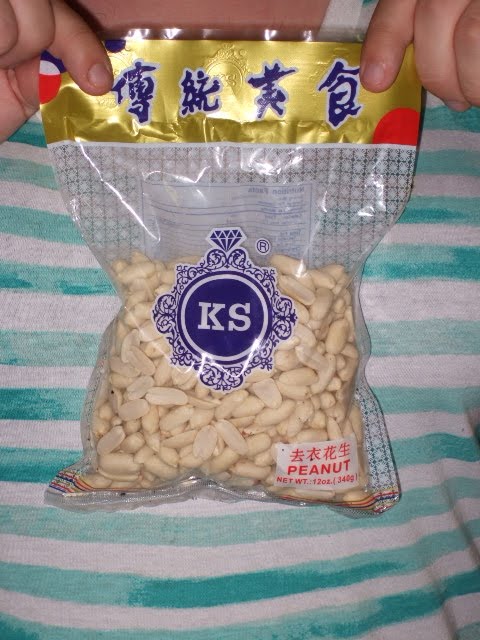
Preheat an oven to 500°, then simply spread them on a cookie sheet, and toss them in the oven for 5 minutes, stir them, and then send them in again. It is advisable to roast more than a cup and a half, because they're rather tasty and it's difficult to avoid eating them. When its all said and done they look like this:

"Discard" (eat) any peanuts that are a little too brown, and grind the rest coarsely in a blender or food processor with the salt and sugar, and dump them on a plate or a pie tin, so that it will be easy to roll dumplings therein.

For the sesame seeds, simply grind them coarsely with a pestle or in a coffee grinder, like so:

You want a consistency like coarse sand. Mix the sesame meal with its sugar on another plate or pie tin.
The kinako comes pre-pulverulent, so you can mix it with its sugar straight away.

There is a traditional type of syrup dango called mitarashi dango, which are flame grilled and so called because they are eaten at the Mitarashi Festival in Kyoto. I didn't get any mirin (cooking rice wine) at the Asian imports store, so I improvised with a bit of red wine, which made these not-so-traditional-but-still-quite-delicious syrup dango.
Stir together the soy sauce, wine or mirin, and sugar in a small sauce pot, and whisk over medium heat until it bubbles like this:

Reduce heat to simmer, and continue cooking for five more minutes or until thick, stirring often. If it seems like it is getting close to burning you can just take it off the burner for a second, but make sure it thickens.
Now to the fun part: dango making. Drain the tofu, and combine it with rice flour with your hands until it looks like this:

Start adding water, a teaspoon at a time, until the mixture forms a stiff dough. When you see it cracking, like this:

You need to add more water. Continue adding water (it shouldn't be much more than six teaspoons) until the mixture is easily malleable and does not crack. You should be able to form it into a creepy alien baby, like this:

You can see it is still cracking a bit, so I added another teaspoon or two of water. If you wanted your dango to be pink you can add strawberry preserves or puree instead of water, for green ones, prepared, sweetened matcha (the drink not just the powder) is great.
Forming the balls is a bit of a trick, but start by squishing a small bit of dough (about two tablespoons) into a rough patty shape thus:

then rolling it into a smooth ball, thus:

Smooth balls are important, because smoothness effects their mouth feel, and unless you're covering them with something opaque, people will notice your inattention to detail. Irregular balls are also more likely to come apart when cooking.
Boil the dumplings. They'll start to float like this:

Continue cooking for about three minutes more and immerse them immediately in ice water.
Set them in the tray of the topping of your choice and spoon the topping mixture on to them, you may have to roll a bit to coat, but if you get the powders to wet they tend to clump, so keep rolling to a minimum, because clumps are not tasty.

Once you get three dango coated, gently skewer them, like so:
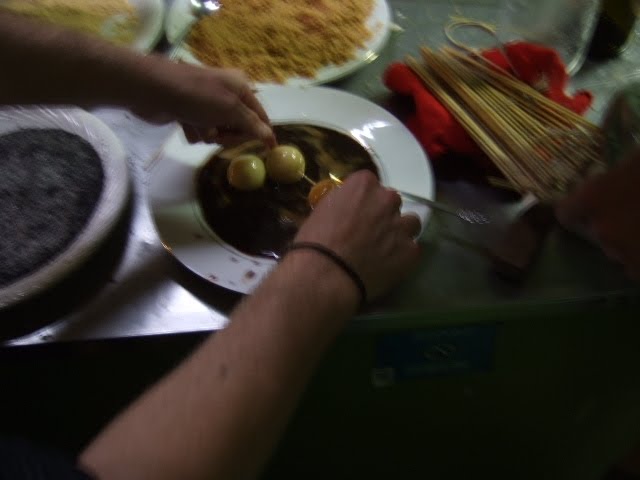
With the last one you want to push the skewer almost (but not quite) all the way through, so it looks like this:

From here the skewers can be transfered to a serving plate or stored in the fridge for about a week. They are better fresh, and I recommend let them warm to room temperature for a bit before you serve them.

Nate and his beard Carlisle agreed to pose with the dango.

So good it must be wrong.
Before I leave you, take a moment to consider the dango as a symbol. The beloved poet Issa (whose pseudonym means roughly "one cup of tea") wrote a great many poems mentioning dango, and he wrote praise for the dango as simple as the dumpling itself, apropos of a sweet that goes so well with tea:

Truth be told,
I prefer, rather than blossoms,
dango
While this translation hardly does it justice, this poem, to me, is about impermanence. Dango and blossoms (some dango are traditional for blossom viewing festivals) are both impermanent, and Issa uses a Japanese idiom, "hana yori dango" which stresses the importance of practical things over frivolous beauty. Dumplings satisfy us in a way that aesthetics cannot, and even we, in the end, are impermanent. I ask that you take this lesson from the dango, abandon your attachment to superficiality, and find instead what nourishes you deeply.I prefer, rather than blossoms,
dango
Especially if that involves balls in your mouth.
Next week the testicle puns and dumpling shenanigans continue with Matzo Ball Soup!


